Dubai · United Arab Emirates
Customs, Transportation & Logistics in Dubai
Dubai handles the largest share of the UAE's container and air cargo, which makes it the emirate where getting the declaration and the collection right has the most immediate cost consequence.
Customs authority
Dubai Customs
Administers customs declarations for goods entering and leaving the emirate of Dubai, with electronic submission through the Dubai Trade portal. Registration and a business code are required to lodge declarations.
Official websiteQuick answer
How does importing goods through Dubai work?
Goods arriving in Dubai are declared to Dubai Customs, which administers declarations electronically through the Dubai Trade platform. The importer or an appointed clearing agent lodges the declaration with the commercial invoice, packing list, transport document and certificate of origin, together with any permit the goods require, then settles duty and applicable VAT before release is granted.
Sea cargo arrives principally at Jebel Ali, with Port Rashid handling other traffic; air cargo moves through Dubai International (DXB) and Al Maktoum International (DWC). Once released, goods can be collected and moved anywhere in the UAE — although a subsequent movement into or out of a free zone is a separate customs procedure.
Our office
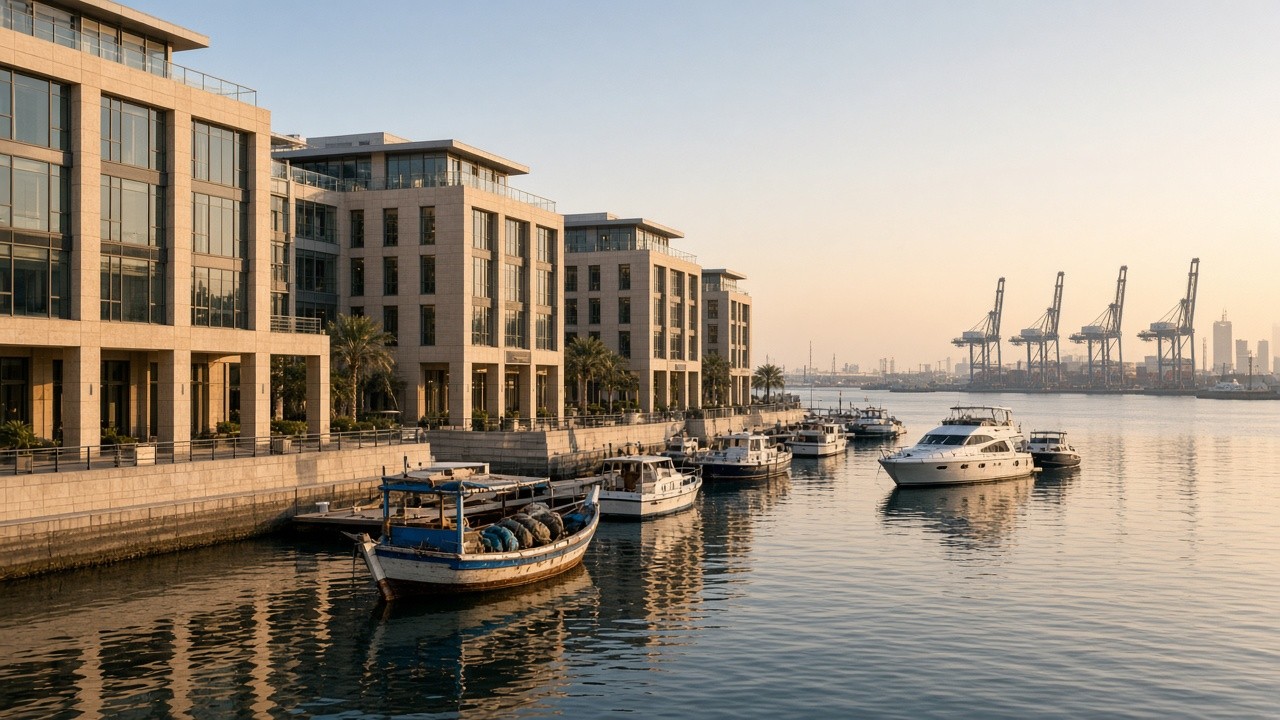
Rashid Yacht Marina, beside Port Rashid
The Dubai office is in Al Ghubaiba — Block B, Office 47 — on the customs and marine side of Bur Dubai, not the Jebel Ali corridor.
Dubai office
Rashid Yacht Marina, Bur Dubai
Next to Port Rashid in Al Ghubaiba — the customs and marine side of Bur Dubai, not the Jebel Ali corridor.
- Block B, Office 47, Rashid Yacht Marina
- Madinat Dubai Al Melaheyah
- Al Ghubaiba, Bur Dubai
- Dubai, United Arab Emirates
- P.O. Box 251885
- Hours
- 07:30am – 06:00pm
- As listed on the company directory. Confirm before visiting.
- Phone
- +971 54 133 7443
- Languages
- English · Arabic · Hindi · Urdu · Pashto
- Payment
- Cash · Bank cheque
- Security Pass Office — Port Rashid · 60 m
- Dubai International Seafarers Center · 200 m
- Dubai Customs Mosque · 250 m
Infrastructure
Ports, airports and free zones in Dubai
The entry points that determine which authority administers your declaration and how far the cargo then has to travel.
Seaports
- Jebel Ali Port
- The UAE's principal container gateway, operated by DP World and adjoining the JAFZA free zone. Most containerised imports for the Dubai market and a large share of regional transhipment move through here.
- Port Rashid
- Closer to central Dubai and now focused on cruise, yacht marina and general traffic rather than mainstream container operations, which were consolidated at Jebel Ali. Our office is at Rashid Yacht Marina, Block B, Office 47, beside the port.
Airports
- Dubai International Airport (DXB)
- A major air cargo gateway with substantial belly-hold and freighter capacity. Suited to time-critical and high-value consignments.
- Al Maktoum International Airport (DWC)
- Dubai South's airport, with dedicated freighter and cargo handling capacity and adjacency to the Dubai South logistics district.
Free zones
- Jebel Ali Free Zone (JAFZA)
- Adjacent to Jebel Ali Port. Widely used for regional distribution and re-export, with the port proximity removing an inland leg.
- Dubai Airport Free Zone (DAFZA)
- Beside DXB, oriented towards air-freighted, high-value and time-sensitive goods.
- DMCC
- A large commercial free zone widely used by trading companies, including commodities.
- Dubai Industrial City and Dubai South
- Industrial and logistics zones aimed at manufacturing, warehousing and distribution operations.
Road access
Getting cargo in and out of Dubai
Corridors, constraints and the practical factors that decide transit time — which is rarely the distance.
- E11 — Sheikh Zayed Road
- The coastal spine running south-west towards Abu Dhabi and north-east into Sharjah. Direct and heavily used, which makes it the least predictable option at peak times for heavy vehicles.
- E311 — Sheikh Mohammed Bin Zayed Road
- The main inland parallel route. Generally the practical choice for freight moving between Jebel Ali, the industrial areas and the northern emirates.
- E611 — Emirates Road
- The outermost bypass, useful for through-traffic to the northern emirates that has no reason to enter the urban core.
- Truck movement restrictions
- Dubai has a standing framework of route and timing restrictions for heavy vehicles, but since March 2026 the RTA and Dubai Police have permitted 24/7 truck movement on Dubai roads until further notice, excluding the Airport Tunnel and Al Shindagha Tunnel. That exemption is revocable, so we confirm the current position for the specific route rather than working from a printed timetable.
Local context
What matters in practice in Dubai
Dubai's advantage for importers is choice. Sea and air options are extensive, free zone and mainland structures are both readily available, and onward road access to the rest of the country is short. That choice is also why decisions here need to be deliberate — the cheapest routing on paper is frequently not the cheapest landed cost.
The practical risk in Dubai is time. Because volumes are high and storage at the terminals is charged, the gap between release being granted and cargo being collected is where avoidable cost accumulates. Having transport arranged in advance of release, rather than after it, is the single largest lever most importers have.
Our office is at Rashid Yacht Marina, Block B, Office 47, in Al Ghubaiba next to Port Rashid — the customs and marine side of Bur Dubai, not the Jebel Ali corridor. Listed hours are 07:30am to 06:00pm; confirm before visiting.
For businesses using JAFZA or DAFZA, the customs position on movement into the mainland is a recurring question rather than a one-off. Establishing it clearly at the outset avoids paying duty at the wrong point or unwinding a transfer later.
Services
What we do in Dubai
Customs consulting
Advice on classification, valuation, permits and documentation before your goods move.
Transportation
Planned movement of goods between UAE ports, free zones, warehouses and delivery points.
Road transportation
Road freight planning: the right vehicle, a workable route and the permits each load needs.
Logistics solutions
One coordinated plan across customs, transport and delivery instead of separate arrangements.
FAQs
Dubai — common questions
Which system are customs declarations submitted through in Dubai?
How quickly can cargo be collected from Jebel Ali after release?
Do you cover both Jebel Ali and the Dubai airports?
Can goods cleared in Dubai be delivered to another emirate?
Can trucks move in Dubai at any time?
Related pages
Next step
Shipping into or out of Dubai?
Tell us the entry point, the cargo and the destination, and we will come back with the customs position and the transport plan.
- No obligation, and no account setup required to get a quote
- We say what we handle ourselves and what we would arrange for you
- If a shipment is not viable as described, we will tell you that too