Abu Dhabi · United Arab Emirates
Customs, Transportation & Logistics in Abu Dhabi
Abu Dhabi's freight profile is industrial and project-weighted. Khalifa Port and the KEZAD zones serve manufacturing, energy and construction supply chains, which brings heavier cargo and stricter site requirements.
Customs authority
Abu Dhabi Customs
Administers customs procedures for goods entering and leaving the emirate of Abu Dhabi, including its seaports, airport and western land border. Requirements and portals differ from other emirates, so the port of entry determines the process.
Official websiteQuick answer
How does importing goods through Abu Dhabi work?
Goods entering the emirate of Abu Dhabi are declared to Abu Dhabi Customs, which administers declarations for the emirate's ports and land entry points within the same federal and GCC customs framework that applies nationally. The document set is comparable to other emirates — commercial invoice, packing list, transport document, certificate of origin and any required permit — but the systems and procedural detail are the emirate's own.
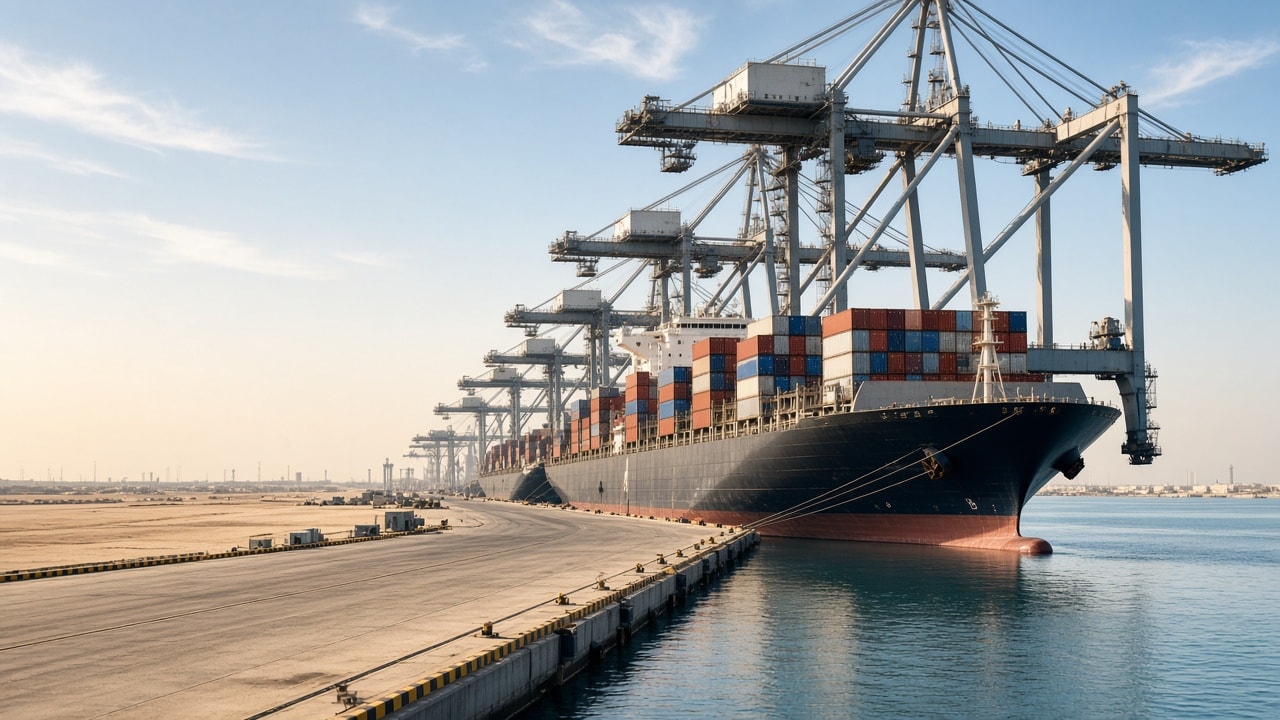
Container and general cargo arrives principally at Khalifa Port, with Zayed Port and Musaffah handling other traffic, and air cargo moving through Zayed International Airport. Onward road distribution runs on the E11 towards Dubai and the northern emirates, and westwards towards the Saudi border at Ghuweifat.
Infrastructure
Ports, airports and free zones in Abu Dhabi
The entry points that determine which authority administers your declaration and how far the cargo then has to travel.
Seaports
- Khalifa Port
- Abu Dhabi's main deep-water container and general cargo port, operated by AD Ports Group and directly adjacent to the KEZAD industrial and logistics zones.
- Zayed Port (Mina Zayed)
- The older port closer to the city, handling cruise and general cargo traffic after container operations were consolidated at Khalifa Port.
- Musaffah Port
- Serves the Musaffah industrial area, oriented towards industrial and offshore-support cargo.
Airports
- Zayed International Airport
- Abu Dhabi's principal airport and air cargo gateway, with an adjoining airport free zone.
Free zones
- KEZAD (Khalifa Economic Zones Abu Dhabi)
- A large industrial and logistics zone cluster adjacent to Khalifa Port, widely used by manufacturing and processing operations. Port adjacency removes an inland leg for heavy inbound materials.
- Abu Dhabi Airport Free Zone
- Positioned for air-freighted and time-sensitive goods alongside Zayed International.
Road access
Getting cargo in and out of Abu Dhabi
Corridors, constraints and the practical factors that decide transit time — which is rarely the distance.
- E11 towards Dubai
- The primary corridor between Abu Dhabi and Dubai, and the route most inter-emirate freight uses. Journey times are measured in hours, but delivery windows at industrial sites usually matter more than the drive.
- E11 west towards Ghuweifat
- The route to the Saudi Arabian land border at Ghuweifat, and the main road link for GCC cross-border freight. Border formalities, not distance, determine realistic transit times.
- Routes towards Al Ain
- Inland connection to Al Ain and the Omani border area at Al Ain/Buraimi, relevant for cross-border movements and for inland industrial destinations.
- Industrial area access
- Deliveries into Musaffah, ICAD and the KEZAD zones typically involve site-specific gate procedures, permits and receiving windows that need confirming before dispatch.
- Heavy-vehicle timing in Abu Dhabi city
- Unlike Dubai's current 24/7 truck permit, Abu Dhabi still restricts heavy vehicles in the city at peak hours, and has banned trucks on specified corridors including Sheikh Maktoum bin Rashid Road (E11) and Al Raha Beach Road (E10), with designated alternatives. Hours and banned segments change by notice, so they are confirmed for the movement rather than assumed.
Local context
What matters in practice in Abu Dhabi
Abu Dhabi's cargo mix leans towards industrial inputs, energy-sector equipment and construction materials rather than fast-moving consumer goods. That changes the logistics problem: loads are heavier, more items are over-dimension, and lifting arrangements at the delivery point are frequently the binding constraint.
For manufacturers, the adjacency between Khalifa Port and the KEZAD zones is a genuine operational advantage — inbound materials can reach the facility without a long inland leg. It also makes the free-zone-versus-mainland customs question central rather than incidental, since it applies to every input the facility imports.
Site access is the recurring practical issue. Industrial and project destinations in the emirate commonly operate gate procedures, security clearance and fixed receiving windows, and a vehicle that arrives outside them waits. Confirming those requirements before dispatch is part of planning the movement, not an afterthought.
Services
What we do in Abu Dhabi
Customs consulting
Advice on classification, valuation, permits and documentation before your goods move.
Cargo transportation
Handling planned around what the cargo is — palletised, containerised, oversized or sensitive.
Road transportation
Road freight planning: the right vehicle, a workable route and the permits each load needs.
Logistics solutions
One coordinated plan across customs, transport and delivery instead of separate arrangements.
FAQs
Abu Dhabi — common questions
Is customs clearance in Abu Dhabi different from Dubai?
Do you deliver into KEZAD and the Musaffah industrial area?
Can you arrange road freight to Saudi Arabia from Abu Dhabi?
What is the advantage of importing through Khalifa Port?
Are heavy vehicles restricted in Abu Dhabi at peak hours?
Related pages
Next step
Shipping into or out of Abu Dhabi?
Tell us the entry point, the cargo and the destination, and we will come back with the customs position and the transport plan.
- No obligation, and no account setup required to get a quote
- We say what we handle ourselves and what we would arrange for you
- If a shipment is not viable as described, we will tell you that too